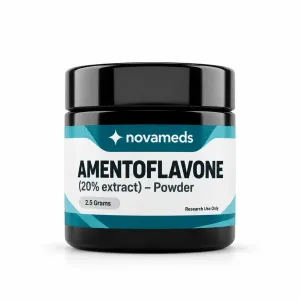
Amentoflavone (20% extract) – Powder, 2.5 grams
Amentoflavone (20% extract) – Powder, 2.5 grams
Actuellement indisponible
Le prix initial était : 32,99 €.23,09 €Le prix actuel est : 23,09 €.
NovaMeds
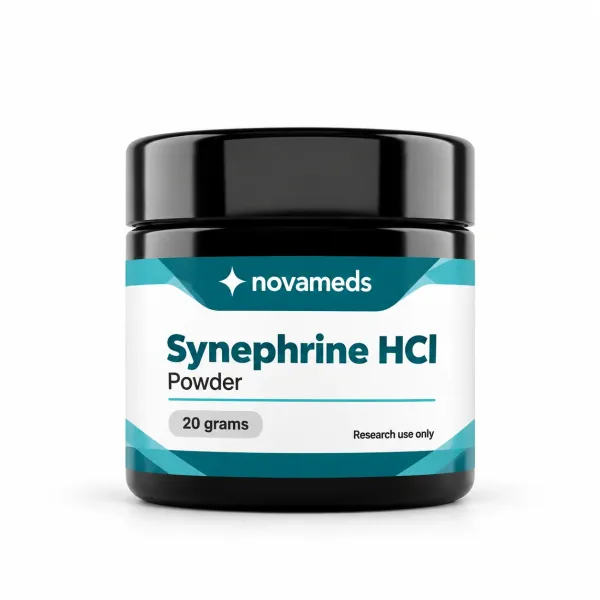
Conditionnement: Synephrine HCl – Powder, 20 grams.
Conditionnement illustratif généré par IA.
Ne pas utiliser chez l’être humain ou l’animal.
Synephrine HCl is the hydrochloride salt form of synephrine, a phenylethanolamine compound studied for its interactions with adrenergic receptor subtypes, with particular research interest in beta-3 adrenergic receptor selectivity relative to other adrenergic agonist compounds. The hydrochloride formulation improves aqueous solubility and stability for precision-based research applications.
Research applications include adrenergic receptor subtype selectivity studies, salt-form pharmacokinetic comparison, and comparative phenylethanolamine pharmacology.
| Chemical Formula | C9H14ClNO2 |
|---|---|
| Synonyms | 4-(1-Hydroxy-2-(methylamino)ethyl)phenol hydrochloride, Oxedrine hydrochloride, Synephrine (hydrochloride), MFCD00050566, Ocuton (TN) |
| Molar Mass | 203.66 g/mol |
| CAS Number | 5985-28-4 |
| PubChem CID | 42609626 |
| Total Compound Content | 20 grams |
| Shelf Life | 36 months |
Synephrine HCl is studied for the same adrenergic receptor-binding profile as the free-base compound, with particular focus on its relative selectivity for beta-3 adrenergic receptors compared to beta-1 and beta-2 subtypes. This compound undergoes hepatic metabolism via monoamine oxidase (MAO) enzymatic degradation and sulfation, with primary clearance occurring through renal excretion. The hydrochloride salt form provides improved aqueous solubility and dissolution characteristics relative to the free base, supporting reproducible stock-solution preparation across in vitro receptor-binding assays and rodent administration protocols. Independently third-party HPLC-tested; COA available per batch.
The hydrochloride salt confers substantially improved aqueous solubility and dissolution rate compared to the free-base form, making it more practical for preparing reproducible stock solutions for in vitro receptor-binding assays and aqueous-vehicle rodent dosing protocols. Researchers should account for the additional mass contribution of the chloride counter-ion when converting between mass-based and molar-based dosing calculations across studies using different salt forms.
Synephrine HCl is studied as undergoing hepatic metabolism primarily via monoamine oxidase (MAO)-mediated oxidative deamination and phase II sulfation conjugation, with the resulting metabolites cleared predominantly through renal excretion. Pharmacokinetic studies characterising these pathways typically use MAO inhibitor co-administration to isolate the contribution of oxidative versus conjugative metabolism to overall clearance, informing dose-timing and metabolite-monitoring decisions in longer-duration in vivo protocols.
Powder format allows researchers to prepare custom-concentration stock solutions tailored to their specific solvent system and required final concentration range, offering greater flexibility for dose-response curve generation than a single fixed-concentration solution product. This is particularly relevant for in vitro receptor-binding assays requiring a wide concentration range to establish full dose-response curves, or for studies requiring a non-aqueous solvent system not compatible with a pre-formulated aqueous solution.
Amentoflavone (20% extract) – Powder, 2.5 grams
Actuellement indisponible
Oleoylethanolamide (OEA) 98%+ – Powder, 5 grams
Actuellement indisponible
7,8-Dihydroxyflavone – Powder, 1 gram
Actuellement indisponible
NAD+ (Nicotinamide Adenine Dinucleotide) – Powder, 10 grams
Actuellement indisponible