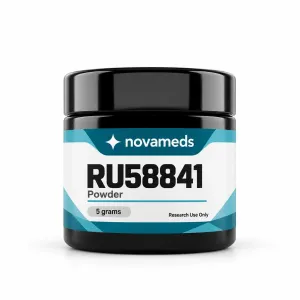
RU58841 – Powder, 5 grams
RU58841 – Powder, 5 grams
Actuellement indisponible
Le prix initial était : 63,99 €.44,79 €Le prix actuel est : 44,79 €.
NovaMeds
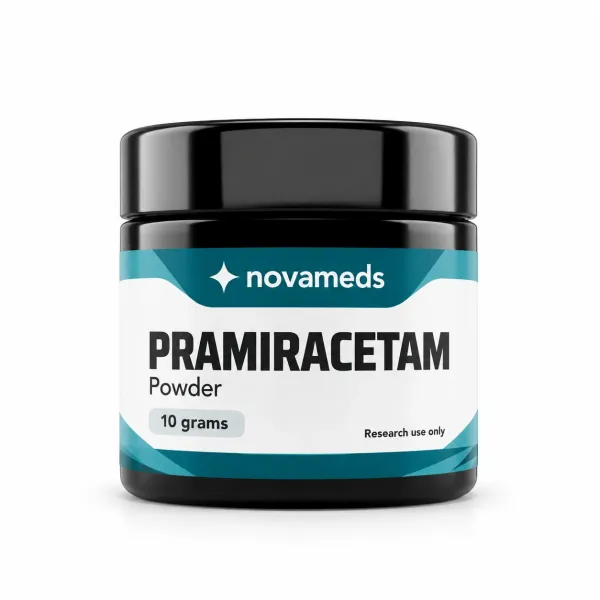
Pramiracetam is a synthetic pyrrolidinone derivative within the racetam structural class, distinguished from other racetam-family compounds by a diisopropylaminoethyl substituent and reported high lipophilicity.
Conditionnement: Pramiracetam – Powder, 10 grams.
Conditionnement illustratif généré par IA.
Ne pas utiliser chez l’être humain ou l’animal.
Pramiracetam is a synthetic pyrrolidinone derivative within the racetam structural class, distinguished from other racetam-family compounds by a diisopropylaminoethyl substituent and reported high lipophilicity. Research interest centers on its proposed effects on high-affinity choline uptake (HACU) in hippocampal tissue models, a mechanism distinct from direct cholinergic receptor agonism.
Research applications include HACU pathway studies, racetam structure-activity relationship investigation, and comparative pyrrolidinone pharmacology.
| Chemical Formula | C14H27N3O2 |
|---|---|
| Synonyms | Pramiracetam 68497-62-1, Pramiracetam [INN], N-[2-[di(propan-2-yl)amino]ethyl]-2-(2-oxopyrrolidin-1-yl)acetamide, UNII-4449F8I3LE |
| Molar Mass | 269.38 g/mol |
| CAS Number | 68497-62-1 |
| PubChem CID | 51712 |
| Total Compound Content | 10 grams |
| Shelf Life | 36 months |
Pramiracetam is studied for its reported capacity to enhance high-affinity choline uptake (HACU) in hippocampal synaptosome preparations, a presynaptic mechanism that increases the availability of choline as a substrate for acetylcholine synthesis without directly agonising postsynaptic cholinergic receptors. This mechanism distinguishes pramiracetam from receptor-targeted cholinergic compounds and positions it within structure-activity relationship research examining how racetam-family substituents (the 2-oxopyrrolidinone core combined with the diisopropylaminoethyl side chain) influence choline transporter interaction. In vitro synaptosome and ex vivo hippocampal slice preparations are standard models for quantifying HACU kinetics under pramiracetam exposure. Independently third-party HPLC-tested; COA available per batch.
Pramiracetam is studied for its capacity to enhance the activity of the high-affinity, sodium-dependent choline transporter located on presynaptic cholinergic nerve terminals, which controls the rate-limiting step of choline availability for acetylcholine biosynthesis.
This is a presynaptic transport-modulating mechanism rather than direct activation of muscarinic or nicotinic acetylcholine receptors, distinguishing pramiracetam’s research profile from receptor-targeted cholinergic agonists. Synaptosome uptake assays using radiolabeled choline are the standard method for quantifying this effect kinetically (Km, Vmax) under compound exposure.
Pramiracetam shares the 2-oxopyrrolidinone (racetam) core structure common to this compound class but is distinguished by a diisopropylaminoethyl acetamide substituent, which confers substantially higher lipophilicity than simpler racetam-family members. Structure-activity relationship research examining the racetam series often uses pramiracetam as a reference point for how side-chain modifications to the shared pyrrolidinone scaffold influence pharmacological profile, including blood-brain barrier penetration characteristics relevant to CNS-targeted in vivo study design.
Ex vivo hippocampal slice preparations and isolated synaptosome fractions are standard models for studying pramiracetam’s effects on cholinergic terminal function, typically measuring choline uptake kinetics directly or acetylcholine release via microdialysis or amperometric methods following compound exposure. Behavioral correlates in rodent models (such as memory-task performance) are sometimes paired with these biochemical measures to connect presynaptic cholinergic effects to functional outcomes, though researchers should treat behavioral and biochemical endpoints as separate lines of evidence requiring independent validation.
RU58841 – Powder, 5 grams
Actuellement indisponible
NSI-189 Phosphate – Powder, 1 gram
Actuellement indisponible
NSI-189 Free Base – Powder, 1 gram
Actuellement indisponible
Dihexa – Powder, 500mg
Actuellement indisponible