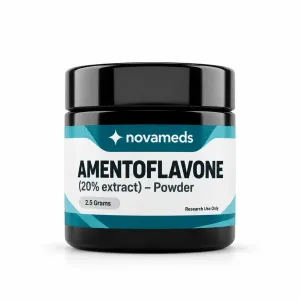
Amentoflavone (20% extract) – Powder, 2.5 grams
Amentoflavone (20% extract) – Powder, 2.5 grams
Actuellement indisponible
Le prix initial était : 32,99 €.23,09 €Le prix actuel est : 23,09 €.
NovaMeds
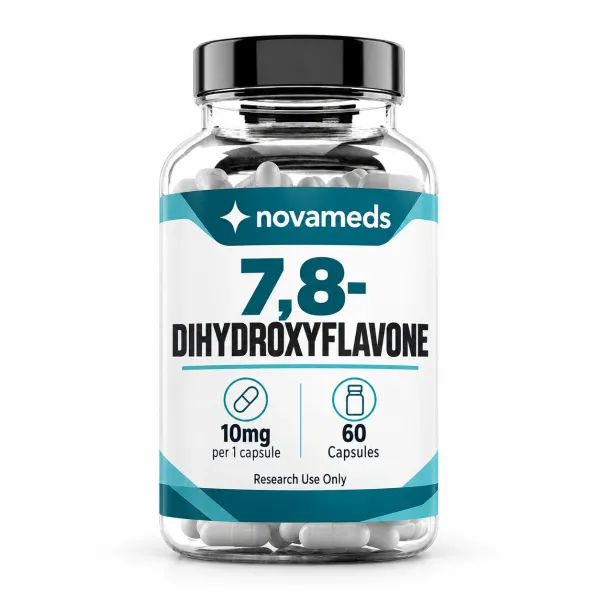
7,8-Dihydroxyflavone (7,8-DHF) is a flavonoid compound studied for specific molecular pathway interactions in experimental models, with laboratory research indicating selective TrkB receptor modulation properties.
Conditionnement: 7,8-Dihydroxyflavone (10mg/capsule), 60 Capsules.
Conditionnement illustratif généré par IA.
Ne pas utiliser chez l’être humain ou l’animal.
7,8-Dihydroxyflavone (7,8-DHF) is a flavonoid compound studied for specific molecular pathway interactions in experimental models, with laboratory research indicating selective TrkB receptor modulation properties. Research interest centers on its proposed role as a tool compound for investigating TrkB receptor-mediated signalling distinct from peptide-based neurotrophic factor research.
Research applications include TrkB receptor pharmacology, comparative flavonoid receptor-modulator studies, and small-molecule neurotrophic signalling research.
| Chemical Formula | C15H10O4 |
|---|---|
| Synonyms | ADB6MA8ZV2, CHEMBL75267, Spectrum_001087, Spectrum2_000952, Spectrum3_000213 |
| CAS Number | 38183-03-8 |
| PubChem CID | 1880 |
| Total Compound Content | 600mg (10mg per 1 capsule) |
| Shelf Life | 36 months |
7,8-Dihydroxyflavone is studied as a flavonoid compound demonstrating selective TrkB receptor modulation properties in laboratory research models. As a small-molecule tool compound, it is investigated for its capacity to engage TrkB receptor signalling pathways through a distinct chemical mechanism relative to peptide-based neurotrophic factor research tools, offering researchers an alternative reagent for dissecting TrkB-dependent cellular signalling without the stability and delivery constraints associated with larger peptide molecules. Comparative receptor-binding and downstream signalling assays are used to characterise its selectivity profile relative to other flavonoid-class and peptide-class TrkB-pathway research compounds. Independently third-party HPLC-tested; COA available per batch.
As a small-molecule flavonoid, 7,8-Dihydroxyflavone offers researchers a chemically stable alternative to peptide-based neurotrophic factor research tools, which often face stability and blood-brain barrier penetration limitations in experimental design. Comparative research examining both compound classes at the TrkB receptor allows investigators to characterise whether observed signalling outcomes depend on receptor engagement mechanism or are specific to one structural class of research tool.
Radioligand displacement assays and surface plasmon resonance are standard methods for quantifying 7,8-Dihydroxyflavone’s binding affinity at the TrkB receptor, typically run alongside parallel assays at related receptor tyrosine kinases (such as TrkA or TrkC) to establish selectivity. These binding data are usually paired with cell-based functional assays measuring downstream receptor autophosphorylation to confirm that binding translates to receptor activation in the specific experimental model under study.
Western blot analysis of TrkB receptor autophosphorylation and downstream kinase cascade activation (such as ERK or AKT pathway markers) in neuronal cell culture models is a standard approach for confirming functional TrkB pathway engagement following compound exposure. These molecular signalling readouts are often paired with cell-based functional assays relevant to the specific research question, allowing researchers to connect receptor-level engagement to downstream cellular outcomes.
Les excipients de la gélule ne sont pas précisés dans la documentation disponible.
Amentoflavone (20% extract) – Powder, 2.5 grams
Actuellement indisponible
Oleoylethanolamide (OEA) 98%+ – Powder, 5 grams
Actuellement indisponible
7,8-Dihydroxyflavone – Powder, 1 gram
Actuellement indisponible
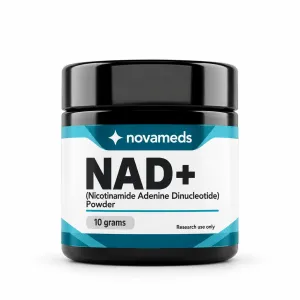
NAD+ (Nicotinamide Adenine Dinucleotide) – Powder, 10 grams
Actuellement indisponible