RU58841 – Powder, 5 grams
RU58841 – Powder, 5 grams
No disponible actualmente
El precio original era: 63,99 €.44,79 €El precio actual es: 44,79 €.
NovaMeds
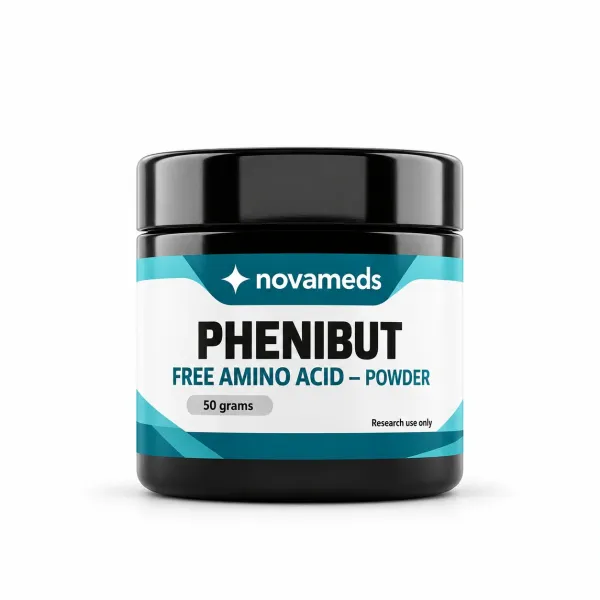
Phenibut Free Amino Acid (FAA) is the free base form of β-phenyl-γ-aminobutyric acid, distinct from Phenibut HCL in that it lacks the hydrochloride salt component.
Presentación: Phenibut Free Amino Acid – Powder, 50 grams.
Envase ilustrativo generado con IA.
No apto para uso humano o veterinario.
Phenibut Free Amino Acid (FAA) is the free base form of β-phenyl-γ-aminobutyric acid, distinct from Phenibut HCL in that it lacks the hydrochloride salt component. The free base form has lower molecular weight, different solubility characteristics, and is used in research applications requiring non-salt formulations. It retains the same GABA-B receptor agonist and GABA-A ρ modulator pharmacological profile as the HCL form.
| Chemical Formula | C10H13NO2 |
|---|---|
| Synonyms | β-Phenyl-GABA (free base), γ-Amino-β-phenylbutyric acid, Fenibut |
| Molar Mass | 179.219 g/mol |
| CAS Number | 1078-21-3 |
| PubChem CID | 14113 |
| Total Compound Content | 50 g powder |
| Shelf Life | 36 months |
Phenibut Free Amino Acid (C10H13NO2; MW 179.22 g/mol) is the free base form of β-phenyl-γ-aminobutyric acid, in contrast to Phenibut HCL (C10H14ClNO2; MW 215.68 g/mol). The free base form has distinct physicochemical properties: lower molecular weight by 36.46 g/mol (the HCl difference), reduced aqueous solubility relative to the salt (approximately 10–15 mg/mL in water vs. ~200 mg/mL for HCL), and higher lipophilicity. In organic solvents (ethanol, DMSO), the free base form has greater solubility than the HCL salt. Researchers select the free base form for formulation studies requiring lipophilic vehicles, sublingual preparations, or assays where chloride ion contamination must be avoided. Pharmacological properties — GABA-B agonism, GABA-A ρ modulation, BBB penetrance via phenyl β-substitution — are identical to the HCL form. Supplied in 50 g bulk powder. Independently third-party HPLC-tested; COA available per batch.
Results refer to the tested sample. Check the batch and date in the report.
The primary differences are solubility and formulation compatibility. Phenibut HCL is highly water-soluble (~200 mg/mL) and suited to aqueous solution preparation. Phenibut Free Amino Acid (free base) has lower water solubility (~10–15 mg/mL) but higher solubility in organic solvents and lipophilic vehicles.
The free base form is preferred for lipophilic formulations, sublingual preparations, or when chloride ions from the HCL salt would confound the assay. Pharmacological activity is equivalent once dissolved; the choice is driven by formulation requirements.
Once absorbed, both forms deliver the same active moiety (β-phenyl-GABA) to the systemic circulation. The salt form has no independent pharmacological activity — the HCl component dissociates in solution. Any pharmacokinetic differences relate to dissolution rate and absorption site pH dynamics rather than inherent compound differences.
In vivo, both forms are expected to produce equivalent plasma concentration profiles at equimolar doses when formulated appropriately.
Phenibut has a pKa of approximately 4.1 (carboxylic acid) and 9.4 (amino group). At physiological pH (~7.4), it exists predominantly in its zwitterionic form. The free base powder is in its neutral/free base state, which has lower water solubility than the protonated HCL salt form. Solubility increases significantly below pH 5, where protonation of the amino group occurs.
This pH-dependent solubility is relevant to in vitro assay design when working in acidic culture conditions or buffer systems.
RU58841 – Powder, 5 grams
No disponible actualmente
NSI-189 Phosphate – Powder, 1 gram
No disponible actualmente
NSI-189 Free Base – Powder, 1 gram
No disponible actualmente
Dihexa – Powder, 500mg
No disponible actualmente