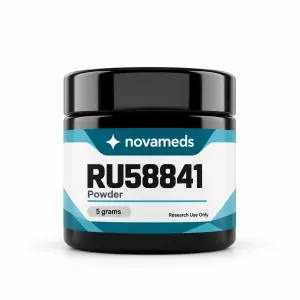
RU58841 – Powder, 5 grams
RU58841 – Powder, 5 grams
No disponible actualmente
El precio original era: 63,99 €.44,79 €El precio actual es: 44,79 €.
NovaMeds
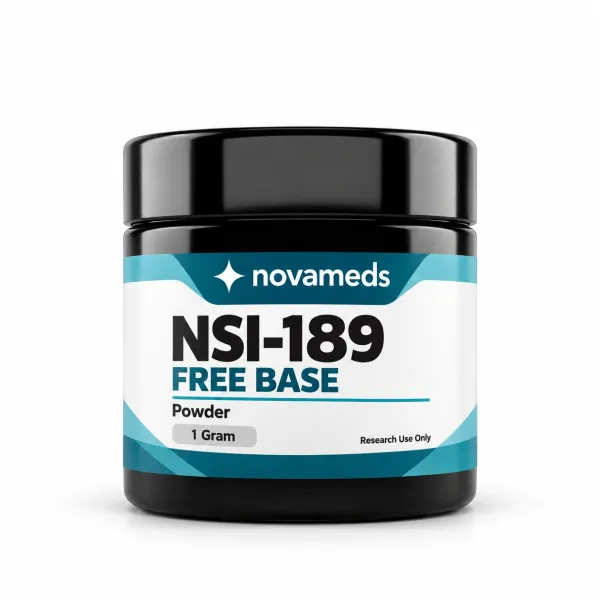
NSI-189 free base is a synthetic benzylpiperazine-aminopyridine derivative investigated for its effects on neural progenitor cell proliferation and neurogenesis-associated pathways.
Presentación: NSI-189 Free Base – Powder, 1 gram.
Envase ilustrativo generado con IA.
No apto para uso humano o veterinario.
NSI-189 free base is a synthetic benzylpiperazine-aminopyridine derivative investigated for its effects on neural progenitor cell proliferation and neurogenesis-associated pathways. Research has focused on progenitor cell expansion, neuronal differentiation markers, and intracellular signalling mechanisms distinct from classical monoaminergic compounds.
Applications include neural progenitor proliferation assays, neurogenesis biomarker studies, and structure-activity relationship (SAR) research. The free-base powder format supports flexible stock-solution preparation and precise concentration-response studies.
| Chemical Formula | C22H30N4O |
|---|---|
| Synonyms | 270138-41-4 UNII-HX0VO60T62 HX0VO60T62 |
| Molar Mass | 366.5 g/mol |
| CAS Number | 1270138-40-3 |
| PubChem CID | 50922681 |
| Total Compound Content | 1 gram |
| Shelf Life | 36 months |
NSI-189 free base is studied for its activity in neural progenitor cell models, where in vitro assays have reported increased progenitor cell proliferation and modulation of neuronal differentiation markers following compound exposure. Experimental studies commonly utilize biomarkers such as doublecortin (DCX) and Ki-67 to characterize neurogenesis-associated activity and cellular turnover. Unlike classical monoaminergic pathway modulators, NSI-189 is investigated for its effects on intracellular signalling pathways associated with progenitor cell growth and survival. The free-base format is useful in research protocols where salt-form counter-ions are not desired in final solution preparation. Independently third-party HPLC-tested; COA available per batch.
Free-base compounds do not contain the counter-ion present in salt forms, which can influence solubility, dissolution characteristics, and final solution pH. Selection between free-base and phosphate formats depends on the solvent system, assay requirements, and desired formulation conditions. When preparing solutions, molar concentration calculations should account for differences in molecular weight between the free base and salt forms.
Comparisons should be normalized to the molar amount of the active compound rather than total mass, since salt forms contain additional molecular weight from the counter-ion. This approach allows direct comparison of concentration-response data across studies using different formulations of the same compound.
Free-base compounds may exhibit different aqueous solubility profiles than corresponding salt forms and can require co-solvents or adjusted solution conditions to achieve complete dissolution. Researchers should verify solubility at intended working concentrations and confirm the absence of precipitation before use in cell-based assays or preclinical research protocols.
RU58841 – Powder, 5 grams
No disponible actualmente
NSI-189 Phosphate – Powder, 1 gram
No disponible actualmente
Dihexa – Powder, 500mg
No disponible actualmente
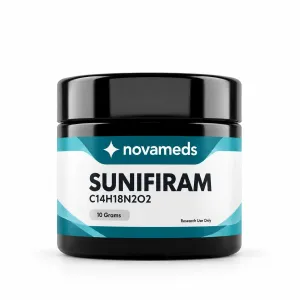
Sunifiram – powder, 10 grams
No disponible actualmente