
- Startseite
- Haut, Haare und Dermatologie
- GHK-Cu Copper Peptide
Haut und Haare
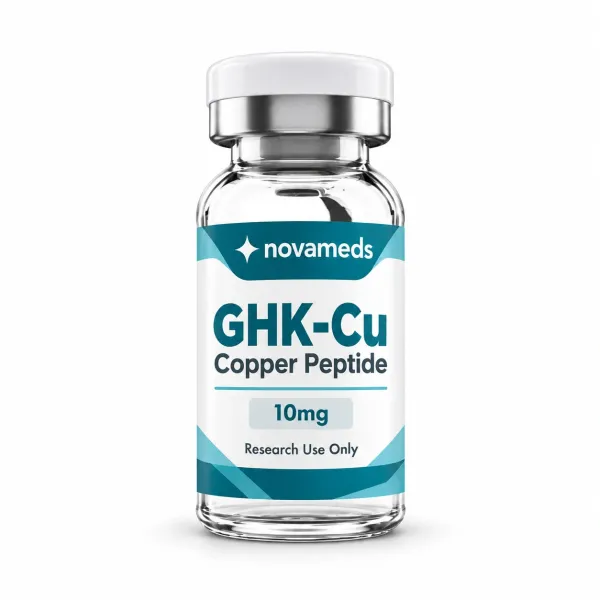
GHK-Cu Copper Peptide
GHK-Cu is a synthetic tripeptide-copper complex demonstrating specific molecular interactions in experimental models.
Darreichungsform: GHK-Cu Copper Peptide.
Gewünschte Stärke und Packungsgröße auswählen.
Mit KI erstellte illustrative Verpackung.
- Partnerapotheke
- Persönliche Betreuung
- Diskrete Lieferung
- DarreichungsformGHK-Cu Copper Peptide
Versand und Lieferung
- Versand in der Regel innerhalb von 24 Stunden nach Zahlungsbestätigung.
- USPS Regular Shipping · 11,95 € · Ca. 3–5 Werktage
- FedEx 2 Days Delivery · 28,99 € · Ca. 2 Werktage
- FedEx Overnight Delivery · 40,99 € · Ca. 1 Werktag
Nur für die Laborforschung.
Nicht zur Anwendung bei Menschen oder Tieren.
Zusammensetzung und Produktdetails
Übersicht
GHK-Cu is a synthetic tripeptide-copper complex demonstrating specific molecular interactions in experimental models. The compound consists of glycyl-L-histidyl-L-lysine sequence chelated with copper, showing unique binding properties in laboratory studies. Research indicates selective cellular pathway modulation in controlled experimental conditions.
- High Purity – 99% Purity Guaranteed
- Independently Lab Tested
- Research Grade Quality
- For Laboratory Research Use Only
GHK-Cu Copper Peptide10mg 1 vial | 10mg KIT (10 vials) | 50mg (1 vial) | 50mg KIT (10 vials)
Eigenschaften
| Chemical Formula | C14H23CuN6O4+ |
|---|---|
| Synonyms | Prezatide copper, Copper peptide, BCP32687, SY253680, GHK copper; CG-copper peptide; [N2-(N-Glycyl-L-histidyl)-L-lysinato(2-)]copper |
| Molar Mass | 402.92 g/mol |
| CAS Number | 89030-95-5 |
| PubChem CID | 78122578 |
| Verfügbare Formate | 10mg 1 vial · 10mg KIT (10 vials) · 50mg (1 vial) · 50mg KIT (10 vials) |
| Shelf Life | 36 months |
Forschung
GHK-Cu is a tripeptide-copper(II) complex composed of Glycine-Histidine-Lysine coordinated to a copper ion through high-affinity metal-binding interactions. The copper(II) ion is chelated primarily through the histidine imidazole group and N-terminal amine, forming a stable coordination complex that has been extensively studied in metallopeptide research. This metal-binding architecture contributes to the compound’s utility as a model system for investigating peptide-copper interactions, coordination chemistry, and copper-dependent signaling processes.
Experimental investigations have examined the relationship between GHK-Cu and signaling pathways associated with extracellular matrix regulation, structural protein organization, metal-ion transport systems, and peptide-mediated cellular communication networks. Additional studies have characterized interactions with copper-dependent regulatory proteins, redox-associated signaling pathways, and metalloprotein activity, contributing to a broader understanding of peptide-metal complex biology. Research applications include metallopeptide pharmacology, copper coordination studies, ligand-metal interaction analysis, structure-function investigations, extracellular matrix-associated signaling research, and mechanistic evaluation of peptide-copper regulatory systems. Independently third-party HPLC-tested; COA available per batch.
Laborergebnisse
Results refer to the tested sample. Check the batch and date in the report.
GHK-Cu (2607-ED-GH)
September 5, 2026
FAQ
What role does the copper(II) ion play in the structure of GHK-Cu?
The copper(II) ion is an essential structural component of GHK-Cu, forming a stable coordination complex through interactions with the Gly-His-Lys tripeptide. This metal-binding arrangement influences the physicochemical properties of the complex and has made GHK-Cu a widely studied model system for investigating copper coordination chemistry, ligand-metal interactions, metallopeptide stability, and copper-dependent signaling mechanisms.
What signaling pathways have been associated with GHK-Cu in experimental investigations?
Research involving GHK-Cu has examined interactions with signaling networks associated with extracellular matrix regulation, structural protein organization, metal-ion transport processes, and peptide-mediated cellular communication. Additional investigations have explored relationships between GHK-Cu and copper-dependent regulatory proteins, redox-associated signaling pathways, and metalloprotein activity, contributing to a broader understanding of metallopeptide signaling systems.
What distinguishes GHK-Cu from other copper-binding peptide complexes?
GHK-Cu combines a well-characterized tripeptide scaffold with high-affinity copper(II) coordination, resulting in a defined metallopeptide structure that has been extensively investigated in coordination chemistry and signaling research. Its established molecular architecture and documented metal-binding properties have made it a valuable reference compound for studies examining ligand-metal interactions, metallopeptide pharmacology, structure-function relationships, and copper-dependent regulatory mechanisms.
Ähnliche Produkte
Haut und Haare 

