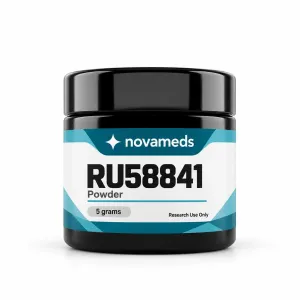
RU58841 – Powder, 5 grams
RU58841 – Powder, 5 grams
Derzeit nicht verfügbar
Ursprünglicher Preis war: 63,99 €44,79 €Aktueller Preis ist: 44,79 €.
NovaMeds

Oxiracetam is a hydroxylated pyrrolidinone derivative within the racetam structural class, distinguished from piracetam by a 4-hydroxy substitution on the pyrrolidinone ring.
Darreichungsform: Oxiracetam – Powder, 50 grams.
Mit KI erstellte illustrative Verpackung.
Nicht zur Anwendung bei Menschen oder Tieren.
Oxiracetam is a hydroxylated pyrrolidinone derivative within the racetam structural class, distinguished from piracetam by a 4-hydroxy substitution on the pyrrolidinone ring. Research interest centers on its proposed effects on glutamatergic AMPA receptor signalling and cholinergic pathway modulation in neuronal models.
Research applications include racetam structure-activity relationship studies, AMPA receptor pharmacology, and comparative pyrrolidinone-class compound research.
| Chemical Formula | C6H10N2O3 |
|---|---|
| Synonyms | oxiracetam 62613-82-5, 2-(4-hydroxy-2-oxopyrrolidin-1-yl)acetamide, 4-Hydroxy-2-oxopyrrolidine-N-acetamide, ISF 2522 |
| Molar Mass | 158.16 g/mol |
| CAS Number | 62613-82-5 |
| PubChem CID | 4626 |
| Total Compound Content | 50 grams |
| Shelf Life | 36 months |
Oxiracetam is studied within the racetam family for its hydroxyl-substituted pyrrolidinone structure, a modification relative to the parent compound piracetam that is investigated for altered pharmacological profile. Proposed mechanisms under research include modulation of glutamatergic transmission via AMPA-type ionotropic glutamate receptors and influence on high-affinity choline uptake in cholinergic synaptic models, positioning oxiracetam as a tool compound for dissecting overlapping glutamatergic and cholinergic contributions to racetam-class pharmacology. Comparative electrophysiology and receptor-binding studies are used to characterise oxiracetam’s relative potency against other racetam-family compounds at these targets. Independently third-party HPLC-tested; COA available per batch.
Oxiracetam differs from piracetam by a hydroxyl group at the 4-position of the shared pyrrolidinone ring.
This structural modification is studied for its influence on receptor-binding affinity and pharmacokinetic properties relative to the parent compound, within structure-activity relationship research mapping how substitutions on the racetam core scaffold alter target engagement at glutamatergic and cholinergic systems.
Comparative binding and functional assays against piracetam and other racetam-family compounds are the standard approach for characterising this relationship.
Patch-clamp electrophysiology in cultured neurons or brain slice preparations is the standard method for characterising compound effects on AMPA receptor-mediated excitatory postsynaptic currents (EPSCs), allowing researchers to quantify changes in current amplitude, kinetics, or desensitization properties following oxiracetam exposure. These functional electrophysiological readouts are typically paired with receptor-binding assays to distinguish direct receptor modulation from indirect effects on presynaptic glutamate release.
Because oxiracetam has been investigated for activity at both glutamatergic AMPA receptors and cholinergic high-affinity choline uptake, it serves as a research tool for studying potential crosstalk or convergent downstream effects between these two neurotransmitter systems on cognitive-relevant cellular endpoints (such as long-term potentiation models). Researchers isolating which pathway drives a given experimental outcome typically use selective antagonists for one system (e.g. an AMPA receptor antagonist) while measuring oxiracetam’s effects on the other, to determine pathway dependence.
RU58841 – Powder, 5 grams
Derzeit nicht verfügbar

NSI-189 Phosphate – Powder, 1 gram
Derzeit nicht verfügbar

NSI-189 Free Base – Powder, 1 gram
Derzeit nicht verfügbar

Dihexa – Powder, 500mg
Derzeit nicht verfügbar