
- Startseite
- Langlebigkeit und Zellgesundheit
- NAD+ (Nicotinamide Adenine Dinucleotide) 100 mg
Langlebigkeit
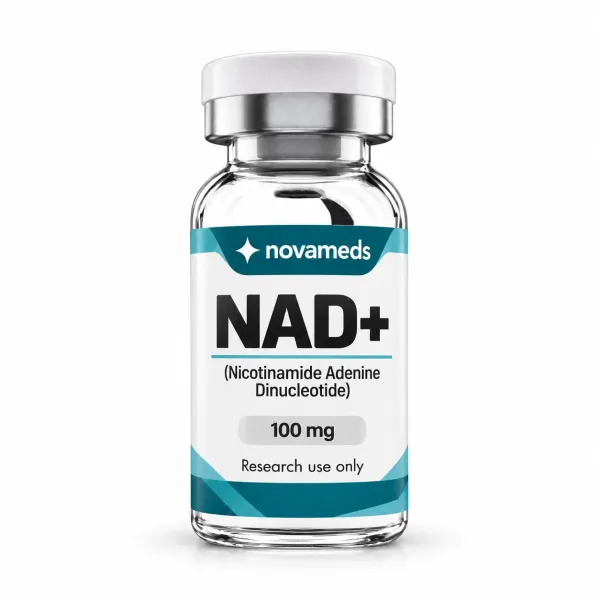
NAD+ (Nicotinamide Adenine Dinucleotide) 100 mg
NAD+ (Nicotinamide Adenine Dinucleotide) is a crucial coenzyme involved in oxidation-reduction (redox) reactions, serving as an electron carrier in cellular bioenergetics.
Darreichungsform: NAD+ (Nicotinamide Adenine Dinucleotide) 100 mg.
Gewünschte Stärke und Packungsgröße auswählen.
Mit KI erstellte illustrative Verpackung.
- Partnerapotheke
- Persönliche Betreuung
- Diskrete Lieferung
- DarreichungsformNAD+ (Nicotinamide Adenine Dinucleotide) 100 mg
Versand und Lieferung
- Versand in der Regel innerhalb von 24 Stunden nach Zahlungsbestätigung.
- USPS Regular Shipping · 11,95 € · Ca. 3–5 Werktage
- FedEx 2 Days Delivery · 28,99 € · Ca. 2 Werktage
- FedEx Overnight Delivery · 40,99 € · Ca. 1 Werktag
Nur für die Laborforschung.
Nicht zur Anwendung bei Menschen oder Tieren.
Zusammensetzung und Produktdetails
Übersicht
NAD+ (Nicotinamide Adenine Dinucleotide) is a crucial coenzyme involved in oxidation-reduction (redox) reactions, serving as an electron carrier in cellular bioenergetics. It plays a fundamental role in metabolic pathways, including glycolysis, the citric acid cycle, and oxidative phosphorylation.
This pyridine nucleotide exists in both oxidized (NAD⁺) and reduced (NADH) states, enabling its function in enzymatic catalysis and cofactor-dependent biochemical reactions. NAD+ is metabolized through enzymatic cleavage, salvage pathways, and poly(ADP-ribose) polymerase (PARP) activity, with primary clearance via renal and hepatic pathways.
NAD+ 100 mg should be reconstituted with bacteriostatic water (BAC).
- High Purity – 99% Purity Guaranteed
- Independently Lab Tested
- Research Grade Quality
- For Laboratory Research Use Only
NAD+ 100mg1 vial | KIT (10 vials)
Eigenschaften
| Chemical Formula | C21H27N7O14P2 |
|---|---|
| Synonyms | nadide, coenzyme I, beta-NAD, beta-nicotinamide adenine dinucleotide |
| Molar Mass | 663.43 g/mol |
| CAS Number | 53-84-9 |
| PubChem CID | 5892 |
| Verfügbare Formate | 1 vial · KIT (10 vials) |
| Shelf Life | 24 months |
Forschung
NAD+ (nicotinamide adenine dinucleotide) is an oxidized dinucleotide consisting of nicotinamide mononucleotide (NMN) and adenosine monophosphate (AMP) linked by a pyrophosphate bridge. As a redox-active cofactor, NAD+ participates in electron-transfer reactions and oxidation-reduction processes throughout numerous biochemical systems, where it is reversibly converted between oxidized (NAD+) and reduced (NADH) states. The NAD+/NADH ratio is a widely studied regulatory parameter that influences the activity of redox-sensitive enzymes, signaling proteins, and cofactor-dependent biochemical pathways.
Beyond redox cycling, NAD+ serves as an obligate substrate for three major enzyme families: PARP-1/-2 (poly(ADP-ribose) polymerases), sirtuins (SIRT1–7, NAD+-dependent deacylases), and CD38/CD157 (ADP-ribosyl cyclases). These enzymes utilize NAD+ in processes involving protein modification, signal transduction, regulatory pathway activation, and cofactor-dependent enzymatic activity. The central role of NAD+ in redox biology and enzyme-cofactor interactions has established it as a valuable research tool for investigating NAD+-dependent signaling networks, sirtuin pharmacology, PARP-associated pathways, and the molecular mechanisms governing cofactor-regulated biochemical systems. Independently third-party HPLC-tested; COA available per batch.
Laborergebnisse
Results refer to the tested sample. Check the batch and date in the report.
HPLC NAD+ (2607-ED-NA)
September 24, 2026
HPLC NAD+ (2607-CY-NA)
September 13, 2026
HPLC NAD+ (2608-CY-NA)
September 13, 2026
HPLC NAD+ (2605-ED-NA)
July 16, 2026
FAQ
How does NAD+ differ from NAD+ precursor compounds in biochemical research?
NAD+ is the oxidized dinucleotide cofactor itself, whereas compounds such as nicotinamide mononucleotide (NMN) and nicotinamide riboside (NR) participate in NAD+ biosynthetic pathways. This distinction makes NAD+ a useful research tool for investigating NAD+-dependent enzymatic reactions, cofactor utilization mechanisms, redox system dynamics, and the biochemical relationships between NAD+ and precursor-associated pathways.
Which enzyme families utilize NAD+ as a substrate?
NAD+ serves as an obligate substrate for three major enzyme families: poly(ADP-ribose) polymerases (PARPs), sirtuins (SIRT1–7), and CD38/CD157 ADP-ribosyl cyclases. These enzymes utilize NAD+ in processes involving protein modification, enzymatic regulation, signal transduction, and cofactor-dependent biochemical activity.
Their dependence on NAD+ has made them important targets for investigations of enzyme-cofactor interactions and NAD+-associated regulatory mechanisms.
Why is NAD+ widely used in biochemical research?
NAD+ occupies a central role in both redox chemistry and enzyme-mediated regulatory systems. In addition to functioning as a reversible electron carrier, it participates directly in the catalytic activity of multiple NAD+-dependent enzyme families.
These characteristics have established NAD+ as a valuable research tool for investigating redox biology, enzyme kinetics, cofactor-dependent catalysis, sirtuin pharmacology, PARP biochemistry, CD38-associated pathways, and the molecular mechanisms governing NAD+-dependent biochemical processes.
Ähnliche Produkte
Langlebigkeit 

