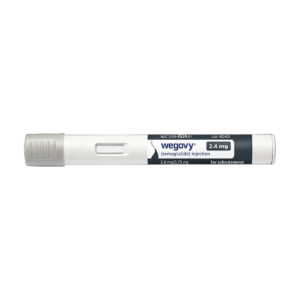
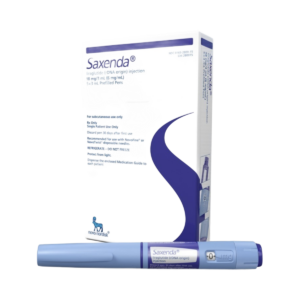
Wegovy and Saxenda are both GLP-1 receptor agonists authorised for weight management, and both are made by Novo Nordisk. They contain different active ingredients, though. Wegovy contains semaglutide and is injected once a week, or taken as a daily tablet. Saxenda contains liraglutide, an earlier molecule, and is injected once a day.
In the one trial that compared them directly, STEP 8, average weight loss over 68 weeks was substantially greater with semaglutide. The two medicines also differ in their authorised uses: Wegovy now has indications beyond weight management, and Saxenda does not.
At a glance
| Wegovy | Saxenda | |
|---|---|---|
| Active ingredient | Semaglutide | Liraglutide |
| Drug class | GLP-1 receptor agonist | GLP-1 receptor agonist |
| Administration | Injection under the skin, or tablet | Injection under the skin |
| Dosing frequency | Injection once weekly; tablet once daily | Once daily |
| Usual maintenance dose | Typically 2.4 mg weekly injection, with other authorised options that vary by formulation and country; or 25 mg daily tablet | 3 mg daily |
| Weight management | Adults; adolescents aged 12 and over (injection) | Adults; adolescents aged 12 and over |
| Other authorised uses | Cardiovascular risk reduction; MASH (UK and US, with differences) | None |
| Generic versions | None | Authorised in the US and UK |
Sources: US prescribing information for Wegovy (revised June 2026) and Saxenda (revised February 2026); UK Summaries of Product Characteristics for Wegovy (September 2026) and Saxenda (November 2025).
Two generations of the same approach
Both medicines imitate glucagon-like peptide-1 (GLP-1), a gut hormone that increases insulin release when glucose is high, slows stomach emptying and acts on appetite centres in the brain.
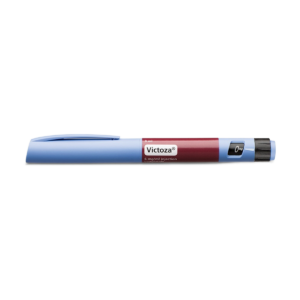
Liraglutide came first. It was approved for type 2 diabetes as Victoza, and then at a higher dose, 3 mg daily, for weight management as Saxenda, first approved by the FDA in December 2014. Its fatty-acid side chain binds it to albumin in the blood, which extends its action to about a day.
Semaglutide is a later refinement. Changes to the peptide backbone and a longer linker between the peptide and its fatty-acid chain strengthen albumin binding and slow breakdown, so its half-life is about a week. That is why Wegovy is injected weekly rather than daily.
How they are used
Saxenda.
- Titration: daily injections start at 0.6 mg and rise by 0.6 mg each week, reaching 3 mg after four weeks in adults.
- Adolescents: titration can take up to eight weeks. In the US, 2.4 mg daily may be used as the maintenance dose if 3 mg is not tolerated.
Saxenda’s licence includes an explicit stopping rule, and the UK and US versions differ.
- UK. For adults, treatment should stop after 12 weeks on 3 mg if at least 5% of initial body weight has not been lost. For adolescents, it should be stopped and re-evaluated if BMI, or BMI z-score, has not fallen by at least 4% after 12 weeks.
- US. Weight is assessed 16 weeks after starting, and treatment stopped if less than 4% has been lost. For adolescents, BMI is assessed after 12 weeks on the maintenance dose, and treatment stopped if it has not fallen by at least 1%.
Wegovy.
- Titration: weekly injections start at 0.25 mg and rise every four weeks, usually to a maintenance dose of 2.4 mg.
- Other options: a 1.7 mg maintenance dose is also authorised. For some adults a 7.2 mg dose is authorised, with different criteria in the UK and US.
- Tablet: Wegovy has also been authorised as a once-daily 25 mg tablet for adults.
The details are set out in Ozempic vs Wegovy and Oral vs Injectable Semaglutide.
Head-to-head evidence: STEP 8
STEP 8 is the only randomised trial to compare the two medicines directly.
Design.
- 68 weeks, at 19 sites in the US.
- 338 adults with obesity, or overweight plus at least one weight-related condition, and without diabetes.
- Participants received once-weekly semaglutide 2.4 mg or once-daily liraglutide 3 mg, each against a matching placebo, alongside diet and physical-activity counselling.
Results (Rubino et al., JAMA 2022):
- Average weight change: −15.8% with semaglutide and −6.4% with liraglutide, a difference of 9.4 percentage points (95% CI 6.8 to 12.0). The pooled placebo group lost 1.9%.
- At least 10% weight loss: 70.9% of people on semaglutide and 25.6% on liraglutide.
- At least 15%: 55.6% and 12.0%.
- At least 20%: 38.5% and 6.0%.
- Stopped treatment for any reason: 13.5% on semaglutide and 27.6% on liraglutide.
- Gastrointestinal side effects: similar in both groups (84.1% and 82.7%).
Three features of the design matter when interpreting it:
- The comparison between the two active medicines was open-label: participants knew whether they were injecting weekly or daily, although each was blinded against its own placebo.
- Titration differed. Semaglutide was increased over 16 weeks and liraglutide over four. Participants who could not tolerate 3 mg of liraglutide stopped treatment, while those who could not tolerate 2.4 mg of semaglutide could stay on 1.7 mg.
- The trial was relatively small and excluded people with diabetes.
None of this overturns the result, but it means the trial compares two treatment strategies, not just two molecules at equal footing.
The wider evidence base
Each medicine also has its own placebo-controlled programme. Comparing figures across these trials is less reliable than a head-to-head trial, because populations, durations and analysis methods differ.
Saxenda. In the main SCALE trial, 3,731 adults without diabetes lost an average of 7.4% of body weight over 56 weeks, against 3.0% with placebo (US prescribing information).
Wegovy. In STEP 1, the corresponding figures over 68 weeks were 14.9% and 2.4% (US prescribing information).
Cardiovascular outcomes. These are where the two diverge most clearly.
- Wegovy is authorised in the UK and US to reduce the risk of major cardiovascular events in adults with established cardiovascular disease and overweight or obesity. This is based on the SELECT outcome trial.
- Saxenda has no cardiovascular indication. No cardiovascular outcome trial of liraglutide at its 3 mg weight-management dose supports one.
Adolescents
Both medicines are authorised for weight management in adolescents aged 12 and over with obesity. For Saxenda, and in the UK for Wegovy as well, this also requires a body weight above 60 kg. The wording differs between labels and countries.
- Saxenda (SCALE Teens). Over 56 weeks, BMI fell by 4.3% with liraglutide and rose by 0.4% with placebo (US prescribing information).
- Wegovy (STEP TEENS). Over 68 weeks, BMI fell by 16.1% with semaglutide and rose by 0.6% with placebo (US prescribing information).
No trial has compared the two directly in adolescents.
Generic liraglutide
Liraglutide is now old enough for generic versions to be authorised. Generics contain the same active ingredient and must meet regulatory standards for quality and equivalence. They are not a different treatment.
- United States.
- The FDA approved the first generic referencing Saxenda (Teva) on 27 August 2025.
- A generic referencing Victoza, the diabetes product, was approved on 23 December 2024.
- United Kingdom.
- Nevolat (Zentiva Pharma UK), a liraglutide product authorised for weight management, was first authorised on 27 March 2024.
- A separate generic liraglutide product (Biocon) is authorised for type 2 diabetes, not weight management.
An authorisation does not guarantee that a product is being supplied in a given market at a given time. There is no generic semaglutide authorised for weight management in the UK or US at the time of writing.
Safety
The two medicines share the class safety profile of GLP-1 receptor agonists:
- common gastrointestinal effects (nausea, diarrhoea, vomiting, constipation), especially during dose increases;
- less common but important risks, including pancreatitis, gallbladder disease, dehydration-related kidney injury and a rise in resting heart rate.
In the US, both labels carry a boxed warning about thyroid C-cell tumours seen in rodents. Both contraindicate use in people with a personal or family history of medullary thyroid carcinoma or multiple endocrine neoplasia type 2. Neither should be used in pregnancy.
A daily injection and a weekly injection also differ in practice: the number of injections, how a missed dose is handled, and how quickly the medicine leaves the body after stopping. Semaglutide remains in the circulation for several weeks.
The patient leaflet has the full list of side effects and precautions. Individual questions are for a doctor or pharmacist.
Frequently asked questions
Is Wegovy the same as Saxenda?
No. Both are GLP-1 medicines for weight management from the same manufacturer, but Wegovy contains semaglutide and Saxenda contains liraglutide.
Which leads to more weight loss?
In STEP 8, the only head-to-head trial, average weight loss at 68 weeks was 15.8% with semaglutide and 6.4% with liraglutide. Individual responses vary, and the choice of treatment depends on clinical circumstances.
Why is Saxenda injected daily and Wegovy weekly?
Liraglutide lasts about a day in the body; semaglutide lasts about a week, because of structural changes that strengthen its binding to albumin and slow its breakdown.
Does Saxenda have a cardiovascular indication?
No. Wegovy’s cardiovascular indication is based on the SELECT trial of semaglutide. There is no equivalent authorisation for Saxenda.
Is there a generic version of Wegovy?
Not for weight management in the UK or US at the time of writing. Generic liraglutide products have been authorised in both countries.
Can someone switch from Saxenda to Wegovy?
Both labels advise against combining GLP-1 receptor agonists. Any switch between them is a prescribing decision, including how to restart dose escalation.
In summary
Saxenda and Wegovy represent two generations of GLP-1 treatment for weight management. Liraglutide is taken daily, has a longer track record and generic versions are now authorised. Semaglutide is taken weekly or as a daily tablet, produced greater weight loss in STEP 8, and has gained cardiovascular and liver-disease indications. Which, if either, is appropriate is a clinical decision.
Related reading: Ozempic vs Wegovy · Semaglutide vs Tirzepatide · Oral vs Injectable Semaglutide · Managing GLP-1 Side Effects: Nausea, Constipation and GI Tolerability
Sources and further reading
- US Food and Drug Administration. SAXENDA (liraglutide) injection — Prescribing Information, revised February 2026 (NDA 206321). Drugs@FDA. Source of SCALE, SCALE Teens, dosing and stopping-rule details.
- US Food and Drug Administration. WEGOVY (semaglutide) injection and tablets — Prescribing Information, revised June 2026 (NDA 215256). Drugs@FDA. Source of STEP 1 and STEP TEENS figures.
- US Food and Drug Administration. Drugs@FDA approval history, NDA 206321 (Saxenda): original approval 23 December 2014; paediatric population 4 December 2020.
- US Food and Drug Administration. 2025 First Generic Drug Approvals: ANDA 214568, liraglutide injection (Teva), reference product Saxenda, approved 27 August 2025.
- US Food and Drug Administration. FDA approves first generic of once-daily GLP-1 injection to lower blood sugar in patients with type 2 diabetes (liraglutide, referencing Victoza). 23 December 2024.
- Novo Nordisk Limited. Saxenda 6 mg/mL solution for injection in pre-filled pen — Summary of Product Characteristics. emc, revised November 2025.
- Novo Nordisk Limited. Wegovy FlexTouch solution for injection in pre-filled pen — Summary of Product Characteristics. emc, revised 22 September 2026.
- Zentiva Pharma UK Limited. Nevolat 6 mg/ml solution for injection in pre-filled pen — Summary of Product Characteristics. emc, revised 15 December 2025 (first authorisation 27 March 2024).
- Biocon Pharma UK Limited. Liraglutide Biocon 6 mg/ml solution for injection in pre-filled pen — Summary of Product Characteristics. emc.
- National Institute for Health and Care Excellence. Liraglutide for managing overweight and obesity. Technology appraisal guidance TA664 (last reviewed 9 December 2020).
- Rubino DM, et al. Effect of weekly subcutaneous semaglutide vs daily liraglutide on body weight in adults with overweight or obesity without diabetes: the STEP 8 randomized clinical trial. JAMA. 2022;327(2):138–150. doi:10.1001/jama.2021.23619
- Pi-Sunyer X, et al. A randomized, controlled trial of 3.0 mg of liraglutide in weight management (SCALE). N Engl J Med. 2015;373(1):11–22. doi:10.1056/NEJMoa1411892
- Wilding JPH, et al. Once-weekly semaglutide in adults with overweight or obesity (STEP 1). N Engl J Med. 2021;384(11):989–1002. doi:10.1056/NEJMoa2032183
- Kelly AS, et al. A randomized, controlled trial of liraglutide for adolescents with obesity (SCALE Teens). N Engl J Med. 2020;382(22):2117–2128. doi:10.1056/NEJMoa1916038
- Weghuber D, et al. Once-weekly semaglutide in adolescents with obesity (STEP TEENS). N Engl J Med. 2022;387(24):2245–2257. doi:10.1056/NEJMoa2208601
- Lincoff AM, et al. Semaglutide and cardiovascular outcomes in obesity without diabetes (SELECT). N Engl J Med. 2023;389(24):2221–2232. doi:10.1056/NEJMoa2307563
This article is educational and does not constitute personalised treatment advice. Treatment decisions depend on individual circumstances and professional assessment.