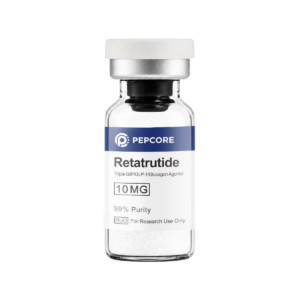
Retatrutide is a once-weekly injectable peptide developed by Eli Lilly. It activates three hormone receptors: those for GIP, GLP-1 and glucagon. Semaglutide acts on one of these receptors and tirzepatide on two. In clinical trials it has produced some of the largest average weight reductions reported for a medicine.
Those results come from trials, and only some have been published in peer-reviewed journals. A regulator has not yet assessed the full evidence on benefit and risk.
At a glance
| Detail | |
|---|---|
| Active ingredient | Retatrutide (LY3437943) |
| Mechanism | Agonist at GIP, GLP-1 and glucagon receptors |
| Administration | Injection under the skin, once weekly (in trials) |
| Development stage | Phase 3 |
| Regulatory status, US | Not approved; application planned for Q1 2027 (company statement); limited pre-approval expanded access |
| Regulatory status, UK | Not authorized |
| Peer-reviewed phase 3 results | TRANSCEND-T2D-1 (Lancet, June 2026); TRIUMPH-2 (Lancet, September 2026) |
| Company-reported phase 3 results not yet peer-reviewed | TRIUMPH-1, TRIUMPH-3, TRIUMPH-4 |
How retatrutide is designed to work
Retatrutide builds on the incretin approach used by semaglutide and tirzepatide, and adds a third target (Coskun et al., Cell Metab 2022). See GLP-1 vs GIP.
- GLP-1 receptor: increases insulin release when glucose is raised, lowers glucagon, slows stomach emptying and reduces appetite.
- GIP receptor: also increases insulin release. Its contribution to weight loss in humans is still debated.
- Glucagon receptor: glucagon normally raises blood glucose. Activating its receptor is thought to increase energy expenditure and fat breakdown in the liver. The GLP-1 and GIP actions are expected to offset the glucose-raising effect.
The idea is that adding glucagon receptor activation to incretin effects increases weight loss and reduces liver fat. The first part is supported by the size of the weight reductions seen in trials, the second by a phase 2 liver-fat substudy (Sanyal et al., Nat Med 2024).
How much each receptor contributes in humans, and in particular whether glucagon receptor activation meaningfully increases energy expenditure over the long term, has not been established.
The development program
Registered studies on ClinicalTrials.gov include:
- phase 1 studies: safety, pharmacokinetics and special populations;
- two phase 2 trials: obesity and type 2 diabetes, both completed with posted results;
- a large phase 3 program, made up of:
- TRIUMPH: obesity and overweight, including people with type 2 diabetes, cardiovascular disease, knee osteoarthritis or obstructive sleep apnea, a head-to-head trial against tirzepatide and a weight-maintenance trial;
- TRANSCEND: type 2 diabetes and chronic kidney disease;
- a cardiovascular and kidney outcomes trial, with completion expected in 2029.
Phase 2 results (peer-reviewed)
Obesity.
- Design: 338 adults with obesity, or overweight with a related condition, and without diabetes (Jastreboff et al., N Engl J Med 2023).
- Weight change at 48 weeks: −24.2% with 12 mg against −2.1% with placebo. Lower doses produced smaller reductions.
- Safety: gastrointestinal side effects were the most common and were dose-related. Heart rate rose in a dose-dependent way, peaking at 24 weeks and declining thereafter.
Type 2 diabetes. A separate phase 2 trial reported reductions in both glycated hemoglobin and body weight (Rosenstock et al., Lancet 2023). A substudy found large reductions in liver fat (Sanyal et al., Nat Med 2024).
Phase 2 trials are designed to choose doses and look for safety signals. Their results do not establish efficacy for approval.
Phase 3 results
Phase 3 results are reaching the public in two ways, and the difference matters.
Published in peer-reviewed journals
- TRANSCEND-T2D-1 (Bajaj et al., Lancet 2026).
- Design: 537 adults with type 2 diabetes not adequately controlled by diet and exercise.
- Glucose control at 40 weeks: glycated hemoglobin fell by 1.69 to 1.94 percentage points with retatrutide 4–12 mg, against 0.81 with placebo.
- Weight at 40 weeks: −11.5% to −15.3% with retatrutide, against −2.6% with placebo.
- TRIUMPH-2 (Bellido et al., Lancet, published online 29 September 2026).
- Design: 1,152 adults with obesity or overweight and type 2 diabetes.
- Weight at 80 weeks (treatment-regimen estimand, which includes people who stopped treatment): −11.9% with 4 mg, −16.8% with 9 mg and −18.8% with 12 mg, against −5.1% with placebo.
- Side effects: gastrointestinal effects were the most common. Low blood pressure and dysaesthesia (abnormal skin sensations) were more frequent with retatrutide.
- Discontinuation: stopping treatment because of adverse events was more common at 9 mg (12%) and 12 mg (8%) than at 4 mg (4%) or with placebo (5%).
Reported by the company, not yet peer-reviewed
Eli Lilly has announced top-line results from further phase 3 trials in press releases. The headline figures use the “efficacy estimand”, which reflects people who continued treatment as planned and gives larger numbers than the treatment-regimen analysis used in published papers.
- TRIUMPH-4 (11 December 2025), in adults with obesity and knee osteoarthritis: at 68 weeks, weight fell by 26.4% with 9 mg and 28.7% with 12 mg, against 2.1% with placebo. Knee pain scores also fell.
- TRIUMPH-1 (21 May 2026), the main obesity trial: at 80 weeks, weight fell by 19.0%, 25.9% and 28.3% with 4, 9 and 12 mg, against 2.2% with placebo. A pre-specified extension to 104 weeks, limited to 532 participants with a BMI of 35 or more who had completed the main study and tolerated their dose, reported up to 30.3%. That figure should not be read as a result for the whole trial.
- TRIUMPH-3 (23 July 2026), in adults with severe obesity and established cardiovascular disease: weight fell by up to 22.6% at 80 weeks.
The difference between estimands is visible in TRIUMPH-2. Lilly’s July 2026 release reported 20.8% with 12 mg (efficacy estimand); the Lancet publication reports 18.8% (treatment-regimen estimand).
Company announcements are selective by nature: full methods, safety data and independent peer review follow later. Until then, these results should be treated as provisional.
What has not been established
Several questions remain open.
- Long-term safety. Early and phase 3 trials have reported increases in heart rate, dysaesthesia and low blood pressure. Whether these matter over years of treatment is not yet known.
- Cardiovascular and kidney outcomes. Weight loss does not by itself show that a medicine reduces heart attacks, strokes or kidney failure. A dedicated outcomes trial is ongoing.
- Comparison with tirzepatide. A head-to-head trial, TRIUMPH-5, is ongoing; no direct comparison has been reported. Comparing figures across separate trials is unreliable.
- Composition of weight lost. How much is fat and how much lean tissue, and what happens after treatment stops, need longer follow-up. A phase 2 body-composition substudy has been published (Coskun et al., Lancet Diabetes Endocrinol 2025).
- Who benefits most. This will depend on the authorized indication, if any, and on regulators’ assessment of benefit and risk.
Regulatory status
United States.
- Approval: retatrutide is not approved.
- Planned filing: in its second-quarter 2026 results, filed with the US Securities and Exchange Commission, Lilly stated that the clinical data package is complete. It plans to submit a Biologics License Application to the FDA in the first quarter of 2027, for obesity, obstructive sleep apnea and knee osteoarthritis pain.
- Expanded access: a pre-approval program is registered on ClinicalTrials.gov (NCT07629401). It provides single-patient access, requested by a treating doctor, for adults who meet all of the following:
- BMI of 35 or more despite the highest available dose of approved weight-management treatment;
- at least two serious or life-threatening obesity-related complications;
- unable to join a clinical trial.
Expanded access is not approval, and the program does not make retatrutide generally available.
United Kingdom. Retatrutide is not authorized in the UK. The MHRA has seized unlicensed products labelled as retatrutide in enforcement operations, including in May 2026. It has warned that such products have not been tested for safety, quality or effectiveness, and may not contain what the label states.
Other regulators have not, to our knowledge, authorized retatrutide either. A future approval in one country would not automatically apply in another.
“Research-grade” retatrutide is not the medicine in the trials
Products sold online as “retatrutide”, often labelled “for research use only”, are not the investigational medicine used in clinical trials.
- No control over contents. Their identity, purity, sterility and dose are not controlled by any medicines regulator.
- No transfer of trial evidence. The trial results describe a specific product, made to pharmaceutical standards and given under medical supervision with monitoring. They do not apply to unregulated material.
- No legal authorization. In the UK, the MHRA considers products sold outside authorized trials likely to be illegal.
Frequently asked questions
Is retatrutide approved?
No. As of 30 September 2026 it is not approved in the US or UK. Lilly plans to apply to the FDA in the first quarter of 2027.
When might retatrutide become available?
That depends on regulatory review, which has not started in the US. No date can be predicted with certainty, and approval is not guaranteed.
Is retatrutide more effective than tirzepatide?
This has not been shown. A head-to-head trial is ongoing, and comparing results across separate trials is unreliable.
How much weight did people lose in the trials?
In the published phase 2 obesity trial, 24.2% at 48 weeks on the highest dose. In the published TRIUMPH-2 trial in people with type 2 diabetes, 16.8% to 18.8% at 80 weeks on the higher doses. Larger figures from TRIUMPH-1 (up to 28.3% at 80 weeks) have so far been reported only by the company, using the efficacy estimand.
Can doctors prescribe retatrutide?
Not as an approved medicine. In the US, a doctor can request access for an individual patient through the expanded-access program if strict criteria are met. Otherwise it is available only in clinical trials.
In summary
Retatrutide is a promising investigational medicine that activates three hormone receptors and has produced large weight reductions in clinical trials. Some phase 3 results are now published; others are still company-reported. It is not approved anywhere we could identify, a US application is planned for early 2027, and long-term safety and outcome data are still being collected. Until a regulator has assessed the evidence, retatrutide should be regarded as an experimental treatment, not an available medicine.
Related reading: GLP-1 vs GIP · Semaglutide vs Tirzepatide · CagriSema: Dual Amylin and GLP-1 Agonism in Clinical Trials
Sources and further reading
- Coskun T, et al. LY3437943, a novel triple glucagon, GIP, and GLP-1 receptor agonist for glycemic control and weight loss: from discovery to clinical proof of concept. Cell Metab. 2022;34(9):1234–1247.e9. doi:10.1016/j.cmet.2022.07.013
- Jastreboff AM, et al. Triple-hormone-receptor agonist retatrutide for obesity — a phase 2 trial. N Engl J Med. 2023;389(6):514–526. doi:10.1056/NEJMoa2301972
- Rosenstock J, et al. Retatrutide, a GIP, GLP-1 and glucagon receptor agonist, for people with type 2 diabetes: a randomized, double-blind, placebo and active-controlled, parallel-group, phase 2 trial conducted in the USA. Lancet. 2023;402(10401):529–544. doi:10.1016/S0140-6736(23)01053-X
- Sanyal AJ, et al. Triple hormone receptor agonist retatrutide for metabolic dysfunction-associated steatotic liver disease: a randomized phase 2a trial. Nat Med. 2024;30(7):2037–2048. doi:10.1038/s41591-024-03018-2
- Coskun T, et al. Effects of retatrutide on body composition in people with type 2 diabetes: a substudy of a phase 2, double-blind, parallel-group, placebo-controlled, randomized trial. Lancet Diabetes Endocrinol. 2025;13(8):674–684. doi:10.1016/S2213-8587(25)00092-0
- Bajaj HS, et al. Efficacy and safety of retatrutide in people with type 2 diabetes and inadequate glycemic control with diet and exercise (TRANSCEND-T2D-1): a double-blind, randomized, phase 3 trial. Lancet. 2026;407(10546):2402–2413. doi:10.1016/S0140-6736(26)00967-0
- Bellido V, et al. Retatrutide in adults with obesity and type 2 diabetes (TRIUMPH-2): a double-blind, parallel-group, randomized, placebo-controlled, phase 3 trial. Lancet. Published online 29 September 2026. doi:10.1016/S0140-6736(26)01861-1
- ClinicalTrials.gov. Retatrutide (LY3437943) study records, including TRIUMPH-1 to -9 (e.g. NCT05929066, NCT05929079, NCT05882045, NCT05931367, NCT06662383) and the cardiovascular and kidney outcomes trial NCT06383390.
- ClinicalTrials.gov. NCT07629401: Pre-approval expanded access of retatrutide (LY3437943). First posted 5 June 2026.
- Eli Lilly and Company. Form 8-K, second-quarter 2026 results (US Securities and Exchange Commission filing): statement on planned Biologics License Application submission in Q1 2027.
- MHRA / GOV.UK. Enforcement news release on seizure of unlicensed weight-loss medicines, including retatrutide, 29 May 2026.
- Eli Lilly and Company. Press releases: TRIUMPH-4 topline results (11 December 2025); TRIUMPH-1 topline results (21 May 2026); TRIUMPH-2 and TRIUMPH-3 topline results (23 July 2026).
This article is educational and does not constitute personalized treatment advice. Treatment decisions depend on individual circumstances and professional assessment.