BPC-157 — 500 µg/capsule · 60 capsules
500 µg/capsule · 60 capsules
Currently unavailable
Original price was: A$96.A$67.20Current price is: A$67.20.
NovaMeds
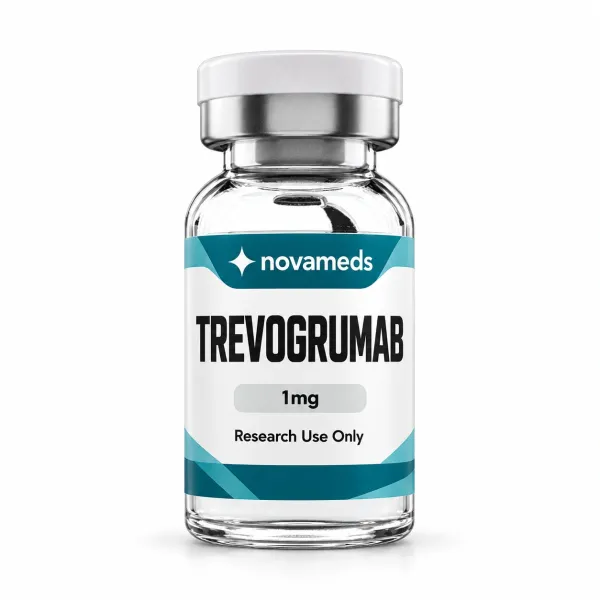
Trevogrumab (REGN1033, SAR-391786) is a fully human monoclonal antibody engineered for high-affinity, selective neutralisation of myostatin (GDF-8), a TGF-beta superfamily ligand that functions as a primary negative regulator of skeletal muscle mass.
Presentation: Trevogrumab 1mg.
Select the required strength and pack size.
Illustrative packaging generated with AI.
Not for human or veterinary use.
Trevogrumab (REGN1033, SAR-391786) is a fully human monoclonal antibody engineered for high-affinity, selective neutralisation of myostatin (GDF-8), a TGF-beta superfamily ligand that functions as a primary negative regulator of skeletal muscle mass. Research interest centers on its specificity for myostatin without cross-reactivity to other ActRIIB-binding ligands such as activins or GDF-11.
Research applications include myostatin pathway antagonist research, antibody-based ligand neutralisation studies, and comparative ActRIIB pathway inhibitor pharmacology.
| Chemical Formula | C6374H9884N1696O2018S46 |
|---|---|
| Synonyms | REGN-1033 (REGN1033), Anti-GDF8/Myostatin antibody, SAR-391786 |
| CAS Number | 1429201-24-0 |
| PubChem CID | 384585220 |
| Available formats | 1 vial · KIT (10 vials) |
| Shelf Life | 36 months |
Trevogrumab is a monoclonal antibody studied for its high-affinity, selective binding to myostatin (GDF-8), neutralising its capacity to engage the activin receptor type IIB (ActRIIB) and downstream Smad2/3 signalling cascade that suppresses skeletal muscle hypertrophy pathways. Its specificity profile distinguishes it from broader-spectrum ActRIIB ligand traps (such as soluble ActRIIB-Fc fusion proteins), which neutralise myostatin alongside activins, GDF-11, and BMP-9/10, making trevogrumab a research tool for isolating myostatin-specific pathway contributions without confounding activin or BMP pathway effects. In vitro Smad2/3 reporter assays and rodent muscle-mass studies are standard experimental approaches for characterising trevogrumab’s neutralising potency and downstream functional effects. Independently third-party HPLC-tested; COA available per batch.
Trevogrumab is engineered as a highly specific anti-myostatin (GDF-8) antibody, binding myostatin directly to prevent its engagement of ActRIIB, with minimal cross-reactivity to other TGF-beta superfamily ligands. This contrasts with soluble ActRIIB-Fc fusion protein ligand traps, which sequester myostatin alongside activins, GDF-11, and BMP-9/10 indiscriminately.
For research questions requiring isolation of myostatin-specific pathway contributions — without confounding effects from co-inhibited activin or BMP signalling — trevogrumab’s selective mechanism is the appropriate experimental tool.
Cell-based Smad2/3 reporter assays — using myoblast cell lines such as C2C12 transfected with a Smad-responsive luciferase construct — are standard for quantifying trevogrumab’s capacity to block myostatin-induced Smad2/3 transcriptional activation in a dose-dependent manner, typically expressed as an IC50 or neutralising dose. Surface plasmon resonance (SPR) or other direct binding-affinity methods are used in parallel to characterise trevogrumab’s intrinsic binding kinetics (Kd, on/off rates) to recombinant myostatin independent of the cell-based functional readout.
Rodent studies investigating myostatin pathway antagonists typically measure lean body mass and individual muscle wet weight (e.g. gastrocnemius, quadriceps) following a defined dosing period, alongside functional measures such as grip strength or treadmill exercise capacity. These studies often include muscle fiber cross-sectional area histology to confirm hypertrophy at the cellular level, and serum myostatin/antibody pharmacokinetic sampling to correlate systemic drug exposure with the magnitude of the observed muscle-mass phenotype.
500 µg/capsule · 60 capsules
Currently unavailable
300 µg/capsule · 60 capsules
Currently unavailable
SLU-PP-332 Peptide
Currently unavailable