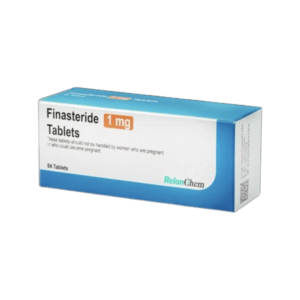
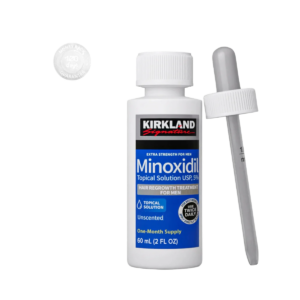
Finasteride and minoxidil are the two most established medicines for androgenetic alopecia, the common, inherited pattern of hair loss. They work in completely different ways.
- Finasteride acts on the hormonal cause. It lowers dihydrotestosterone (DHT), the androgen that gradually shrinks susceptible hair follicles.
- Minoxidil acts on the hair follicle and the hair growth cycle, independently of hormones.
Because their mechanisms differ, they are not alternatives in the sense of two versions of the same treatment. Their authorised uses, who can use them and their safety considerations also differ, including between the UK and the US.
At a glance
| Finasteride | Minoxidil | |
|---|---|---|
| Mechanism | Blocks 5-alpha-reductase type II, lowering DHT | Acts on the follicle to prolong the growth phase; mechanism only partly understood |
| Authorised form for hair loss | 1 mg tablet, once daily | Topical solution or foam, applied to the scalp |
| Who it is authorised for (hair loss) | Men only | Men and women (strengths and schedules differ) |
| UK status | Prescription-only medicine | Topical products authorised for use without prescription |
| US status | Prescription | Topical products authorised for over-the-counter sale |
| Oral minoxidil | Not applicable | Authorised only for severe hypertension; use for hair loss is off-label |
| Time to see an effect | Usually 3–6 months | Usually 2–4 months or more |
| If treatment stops | Benefit reverses over about 9–12 months | Regrowth is lost over the following months |
Sources: UK Summaries of Product Characteristics for Propecia (revised June 2026), Regaine for Men Extra Strength and Regaine for Women (emc), and Loniten; US prescribing information for Propecia and US Rogaine labelling.
Why hair thins in androgenetic alopecia
In androgenetic alopecia, genetically susceptible scalp follicles respond to androgens by gradually shrinking, a process called miniaturisation. Over successive hair cycles:
- the growth phase (anagen) shortens;
- hairs become finer and shorter, until some follicles produce only barely visible vellus hairs.
DHT, formed from testosterone by the enzyme 5-alpha-reductase, is the main androgen involved. The pattern is typically receding temples and thinning crown in men, and diffuse thinning over the top of the scalp in women.
The two medicines intervene at different points in this process:
- finasteride reduces the hormonal signal;
- minoxidil acts on the follicle’s growth cycle.
How finasteride works
Finasteride inhibits the type II form of 5-alpha-reductase, reducing the conversion of testosterone to DHT in the scalp and blood. With less DHT, miniaturisation slows, and in some men follicles partially recover.
Evidence. In two one-year trials in 1,553 men aged 18 to 41, finasteride 1 mg daily improved hair counts, patient and investigator assessments, and expert photographic review compared with placebo. Hair counts in a defined vertex area were higher than with placebo by 107 hairs at one year and 138 at two years, while men on placebo continued to lose hair (Kaufman et al., J Am Acad Dermatol 1998).
Time course. According to the UK product information:
- stabilisation is usually seen after three to six months;
- if treatment stops, the benefit begins to reverse by six months and returns to baseline by nine to twelve months.
Authorisation. In both the UK and the US, finasteride 1 mg is authorised for men only. It is not indicated for women or for children and adolescents.
The comparison with dutasteride, a related medicine, is covered in Finasteride vs Dutasteride.
How minoxidil works
Minoxidil was first developed as an oral treatment for severe high blood pressure. Increased hair growth was noticed as a side effect.
Its mechanism in hair loss is still only partly understood (Messenger and Rundegren, Br J Dermatol 2004). The main proposals are:
- Potassium channels. It opens potassium channels in the follicle.
- Growth cycle. It prolongs the growth phase and enlarges miniaturised follicles.
- Activation in the scalp. It may need to be converted to its active form, minoxidil sulfate, by the enzyme sulfotransferase in the scalp. Differences in this enzyme’s activity have been studied as one reason why responses vary between people.
Minoxidil does not change DHT. It does not stop the underlying hormonal process, which is one reason it is often considered alongside, rather than instead of, other treatments.
Topical minoxidil: evidence. In a 48-week trial in 393 men, 5% topical minoxidil was superior to both 2% and placebo in hair counts and in patient and investigator assessments. It also acted earlier, but caused more itching and local irritation (Olsen et al., J Am Acad Dermatol 2002).
Topical minoxidil: authorisation.
- UK. Topical minoxidil products are authorised for men and for women aged 18 to 65.
- Men: the 5% solution is applied twice daily.
- Women: a 5% foam once daily; a lower-strength solution is also authorised.
- US. Topical minoxidil is sold over the counter for men and women.
In both countries continued use is needed to keep any regrowth.
Oral minoxidil. Taking minoxidil by mouth at low doses, far below those used for blood pressure, has become increasingly common in dermatology. Oral minoxidil tablets are authorised in the UK and US only for severe hypertension, so their use for hair loss is off-label.
The evidence so far comes from two main studies:
- A randomised trial. In 90 men, oral minoxidil 5 mg daily was not superior to 5% topical minoxidil for hair density at 24 weeks. Photographic assessment favoured the oral form on the crown. Excess hair growth elsewhere on the body (hypertrichosis) occurred in 49% of those on oral minoxidil (Penha et al., JAMA Dermatol 2024).
- A large safety study. A retrospective study of 1,404 patients on low-dose oral minoxidil reported hypertrichosis in 15.1%. Systemic effects were uncommon: light-headedness 1.7%, fluid retention 1.3% and fast heartbeat 0.9% (Vañó-Galván et al., J Am Acad Dermatol 2021). It had no control group.
These studies are informative, but they are not the large, long-term trials that underpin authorised treatments.
Head-to-head, and in combination
Finasteride and minoxidil have rarely been compared directly in large trials, and figures from separate trials are not reliably comparable.
What has been studied is combination treatment. A 2020 meta-analysis of five randomised trials found better overall photographic improvement with finasteride plus topical minoxidil than with either alone, with similar rates of adverse events (Chen et al., Aesthetic Plast Surg 2020). The authors noted that the trials were small and of variable quality. Only two compared the combination with finasteride alone.
The rationale for combining them follows from their mechanisms. One slows the hormonal driver of hair loss; the other acts on the follicle’s growth. European guidelines discuss both as treatment options for men, and topical minoxidil for women (Kanti et al., J Eur Acad Dermatol Venereol 2018).
Whether a combination, a single treatment or no treatment is appropriate is an individual decision, made with a clinician. It depends on the pattern and extent of hair loss, sex, medical history and preferences.
Safety
The two medicines have very different safety profiles.
Finasteride. The best-known side effects are sexual: reduced libido, erectile dysfunction and ejaculation disorders. Depression and suicidal thoughts have also been reported. UK regulators have strengthened their advice twice:
- 2024: the MHRA introduced a patient alert card for finasteride.
- May 2026: following a further review, the MHRA advised that finasteride is associated with depression, suicidal ideation and sexual dysfunction that may persist after treatment stops. Its advice to prescribers and patients:
- prescribers should ask about any history of depression and review patients regularly;
- men taking finasteride 1 mg should stop and contact a healthcare professional if they develop depression or suicidal thoughts.
The US product information also lists depression and suicidal ideation and behaviour among post-marketing reports.
Finasteride must not be used by women who are or may become pregnant, because it can affect the development of a male fetus. Crushed or broken tablets should not be handled by them. These issues are discussed in more depth in Finasteride vs Dutasteride.
Topical minoxidil. The most common effects are local:
- itching, irritation and dryness of the scalp;
- sometimes unwanted facial hair, particularly in women.
A temporary increase in shedding can occur in the first weeks. The UK and US labelling advises stopping and seeking advice if chest pain, a rapid heartbeat, dizziness or swelling occur, because a small amount is absorbed into the body.
Oral minoxidil. At low doses the most frequent effect is hypertrichosis. Less common effects include light-headedness, fluid retention and a faster heart rate. At the higher doses used for blood pressure, oral minoxidil is a potent medicine with serious warnings. This is one reason off-label use for hair loss requires medical assessment and monitoring.
The product information for each medicine contains the full list of side effects. Individual questions are for a doctor or pharmacist.
Frequently asked questions
Is finasteride or minoxidil more effective?
They work differently and have rarely been compared directly in large trials. Both have shown benefit over placebo, and combination treatment has been associated with better results than either alone in small trials.
Can women use finasteride?
Finasteride is not authorised for women in the UK or US, and it must not be used during pregnancy. Topical minoxidil is authorised for women.
Is oral minoxidil approved for hair loss?
No. Oral minoxidil is authorised in the UK and US only for severe hypertension. Its use for hair loss is off-label and requires a prescriber’s assessment.
What happens if I stop treatment?
With either medicine, benefits gradually reverse after stopping. For finasteride, the UK product information describes a return to baseline within about nine to twelve months.
How long before results are visible?
Usually several months. Finasteride typically takes three to six months to show stabilisation, and topical minoxidil at least two to four months.
Do finasteride side effects go away after stopping?
In the original clinical trials, sexual side effects were reported by 3.8% of men on finasteride and 2.1% on placebo. They resolved in men who stopped treatment and in most of those who continued (US prescribing information). Since then, post-marketing reports of sexual dysfunction persisting after treatment stopped have been acknowledged by regulators, including the MHRA. Anyone with concerns should speak to a healthcare professional.
In summary
Finasteride and minoxidil treat the same condition from opposite directions.
- Finasteride lowers DHT. It is a prescription tablet for men and carries important warnings about sexual and psychiatric side effects, strengthened in the UK in 2026.
- Minoxidil acts on the follicle. Topical minoxidil is authorised for non-prescription use in men and women. Low-dose oral use is increasingly common but remains off-label.
Evidence supports each over placebo and suggests that combining them can help some people. The right approach is a clinical decision.
Related reading: Finasteride vs Dutasteride · GHK-Cu Copper Peptide: Evidence for Skin Remodelling and Wound Repair
Sources and further reading
- Organon. Propecia 1 mg film-coated tablets — Summary of Product Characteristics. emc, revised 29 June 2026.
- US Food and Drug Administration. PROPECIA (finasteride) tablets — Prescribing Information, revised July 2022 (NDA 020788). Drugs@FDA.
- McNeil Products Ltd. Regaine for Men Extra Strength Scalp Solution 5% w/v — Summary of Product Characteristics. emc, revised 17 December 2024.
- McNeil Products Ltd. Regaine for Women Once a Day Scalp Foam 5% w/w — Summary of Product Characteristics. emc, revised 12 May 2026.
- Pfizer Limited. Loniten 2.5 mg tablets — Summary of Product Characteristics. emc, revised February 2026.
- US Food and Drug Administration. Rogaine (minoxidil topical) labelling, NDAs 019501, 020834 and 021812 (2026 labelling).
- MHRA. Drug Safety Update: Finasteride — reminder of the risk of psychiatric side effects and of sexual side effects (which may persist after discontinuation of treatment). 2024.
- MHRA. Drug Safety Update: Finasteride and dutasteride — updated safety warnings for psychiatric side effects and sexual dysfunction. 11 May 2026.
- Kaufman KD, et al. Finasteride in the treatment of men with androgenetic alopecia. J Am Acad Dermatol. 1998;39(4 Pt 1):578–589. doi:10.1016/s0190-9622(98)70007-6
- Olsen EA, et al. A randomized clinical trial of 5% topical minoxidil versus 2% topical minoxidil and placebo in the treatment of androgenetic alopecia in men. J Am Acad Dermatol. 2002;47(3):377–385. doi:10.1067/mjd.2002.124088
- Messenger AG, Rundegren J. Minoxidil: mechanisms of action on hair growth. Br J Dermatol. 2004;150(2):186–194. doi:10.1111/j.1365-2133.2004.05785.x
- Penha MA, et al. Oral minoxidil vs topical minoxidil for male androgenetic alopecia: a randomized clinical trial. JAMA Dermatol. 2024;160(6):600–605. doi:10.1001/jamadermatol.2024.0284
- Vañó-Galván S, et al. Safety of low-dose oral minoxidil for hair loss: a multicenter study of 1404 patients. J Am Acad Dermatol. 2021;84(6):1644–1651. doi:10.1016/j.jaad.2021.02.054
- Chen L, et al. The efficacy and safety of finasteride combined with topical minoxidil for androgenetic alopecia: a systematic review and meta-analysis. Aesthetic Plast Surg. 2020;44(3):962–970. doi:10.1007/s00266-020-01621-5
- Kanti V, et al. Evidence-based (S3) guideline for the treatment of androgenetic alopecia in women and in men — short version. J Eur Acad Dermatol Venereol. 2018;32(1):11–22. doi:10.1111/jdv.14624
This article is educational and does not constitute personalised treatment advice. Treatment decisions depend on individual circumstances and professional assessment.