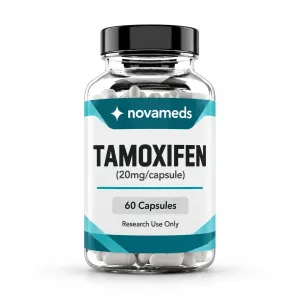
Tamoxifen (20mg/capsule), 60 Capsules
Tamoxifen (20mg/capsule), 60 Capsules
Currently unavailable
Original price was: C$111.95.C$78.37Current price is: C$78.37.
NovaMeds
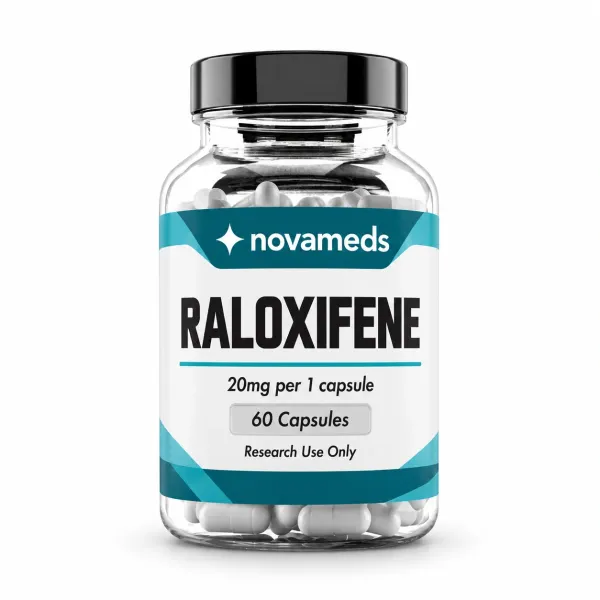
Raloxifene is a selective estrogen receptor modulator (SERM) that exhibits tissue-specific agonist and antagonist activity at estrogen receptors (ERs).
Presentation: Raloxifene (20mg/capsule), 60 Capsules.
Illustrative packaging generated with AI.
Not for human or veterinary use.
Raloxifene is a selective estrogen receptor modulator (SERM) that exhibits tissue-specific agonist and antagonist activity at estrogen receptors (ERs). It interacts with ERα and ERβ, influencing gene transcription and receptor-mediated signaling pathways.
This compound undergoes hepatic metabolism primarily via glucuronidation, producing inactive glucuronide conjugates.
| Chemical Formula | C28H27NO4S |
|---|---|
| Synonyms | Keoxifene, LY156758 |
| Molar Mass | 473.58 g/mol |
| CAS Number | 84449-90-1 |
| PubChem CID | 5035 |
| Total Compound Content | 5 grams |
| Shelf Life | 36 months |
Raloxifene binds competitively to both estrogen receptor subtypes (ERα and ERβ), producing conformational changes in the receptor that recruit different coactivator/corepressor complexes depending on the target tissue — the structural basis of its tissue-selective agonist/antagonist profile. In bone tissue, this conformation favors estrogen-agonist-like signaling, supporting research into its effects on bone mineral density and osteoclast activity. In breast and uterine tissue, the resulting conformation instead favors antagonist activity, a key research contrast point against tamoxifen, which retains partial agonist activity in the endometrium. Research models frequently compare raloxifene against tamoxifen and other SERMs to characterize how ligand structure determines coactivator recruitment and downstream tissue selectivity. Unlike tamoxifen, raloxifene does not require CYP2D6-mediated metabolism to an active form, making it a useful comparative tool in studies of SERM pharmacokinetics and metabolic activation pathways. Independently third-party HPLC-tested; COA available per batch.
Results refer to the tested sample. Check the batch and date in the report.
Both compounds bind the estrogen receptor, but the resulting receptor conformation differs in ways that alter coactivator/corepressor recruitment by tissue. Raloxifene’s conformation favors antagonist activity in both breast and endometrial tissue, whereas tamoxifen retains partial agonist activity in the endometrium.
This divergence makes head-to-head SERM studies a common approach for mapping how structural differences in ligands translate into tissue-specific transcriptional outcomes.
Because raloxifene’s receptor conformation in bone tissue favors estrogen-agonist-like signaling, it is used in osteoblast/osteoclast culture models and in vivo bone density studies to examine estrogen-receptor-mediated effects on bone turnover, independent of the antagonist activity it shows in reproductive tissue.
Raloxifene undergoes extensive glucuronidation rather than requiring CYP2D6-mediated bioactivation, unlike tamoxifen, which depends on CYP2D6 conversion to its active metabolite endoxifen. This makes raloxifene a useful comparator in research examining how metabolic activation requirements affect SERM activity and inter-individual variability tied to CYP2D6 polymorphisms.
Capsule excipients are not specified in the available product documentation.
Tamoxifen (20mg/capsule), 60 Capsules
Currently unavailable
Letrozole (1mg/capsule), 60 Capsules
Currently unavailable
Liothyronine T3 (0.05mg/60caps)
Currently unavailable
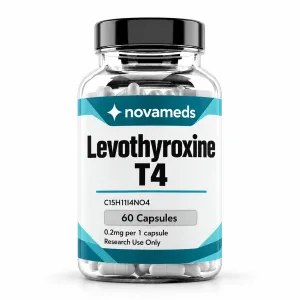
Levothyroxine T4 (0.2mg/60caps)
Currently unavailable